







Flying from Da Nang for a visa run: Vietnamese law and re-entry documents
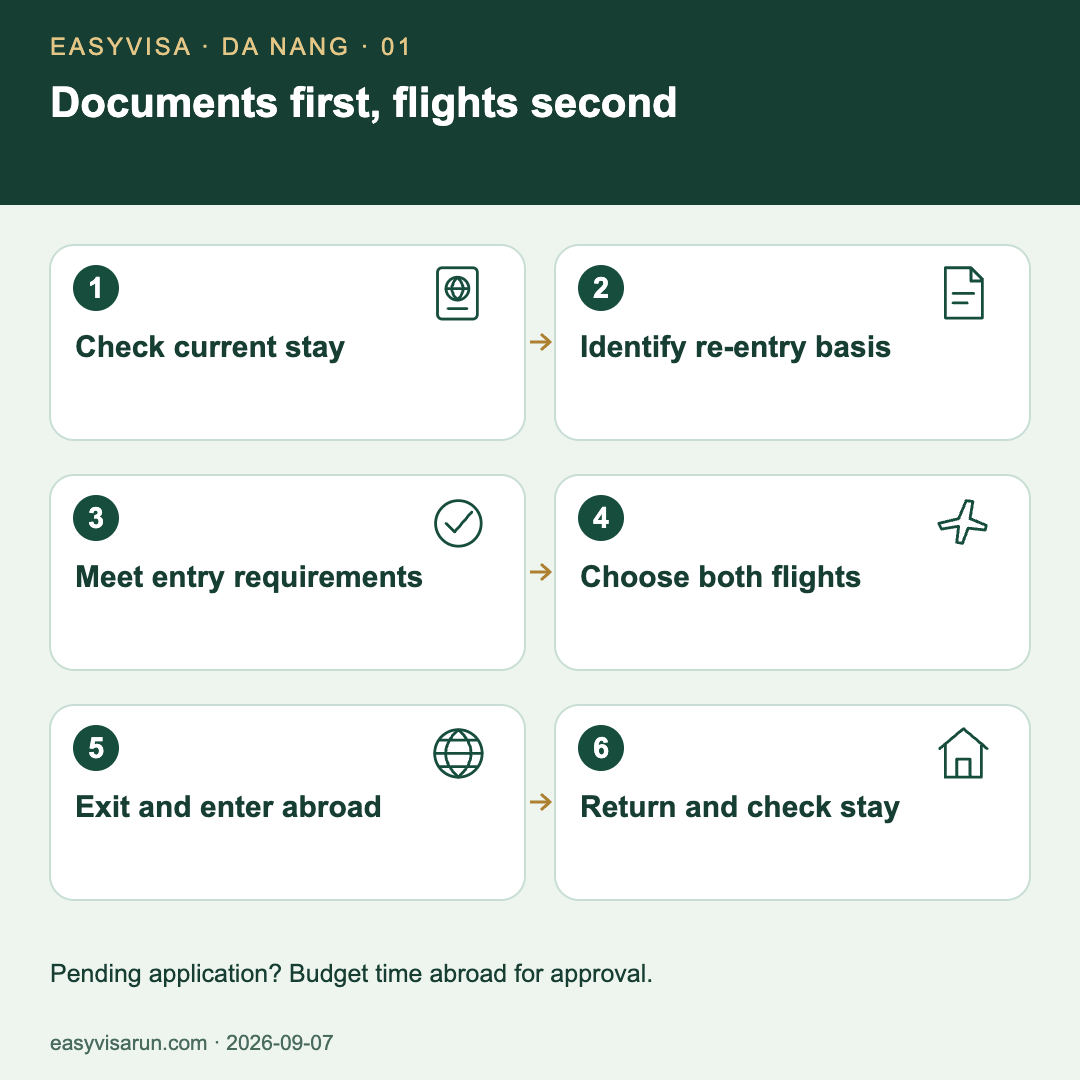
Flying abroad and back to Da Nang is an exit followed by a new entry. It does not extend your existing visa, erase an overstay or automatically grant another 90 days. Establish the legal basis for your return before choosing flights.
Part 1 of our three-part air visa-run series is for foreign passport holders staying in Da Nang. Research was checked on 7 September 2026 against consolidated law 62/VBHN-VPQH dated 23 March 2026 and the official sources linked below.
1. What does Vietnamese law actually provide?
Visa run is an informal name for a journey, not a statutory visa category. Law 47/2014/QH13, amended by Laws 51/2019/QH14 and 23/2023/QH15 and the legislation reflected in the current consolidated text, governs entry, exit, visas and residence.
Article 35 provides a procedure for requesting a temporary-stay extension through an inviting or sponsoring organisation or individual, subject to the competent authority’s consideration. Do not assume that every tourist can extend inside Vietnam, or that everyone must leave. Travellers with employment, investment, family or sponsorship grounds should investigate the applicable in-country procedure before paying for flights.
For a flight itinerary, Articles 20–21 govern entry conditions and grounds for refusal on return; Articles 27–28 concern departure and suspension of exit. A return ticket does not replace those requirements.
2. Identify which document can support your return
Article 9, as amended in 2023, allows EV visas for up to 90 days; Article 7 permits single or multiple entries. The maximum is not an automatic grant to every applicant, and multiple entry does not restart a 90-day period after each flight. Read the actual start date, expiry date and entry count.
| Situation | What to check | What it does not mean |
|---|---|---|
| Valid multiple-entry e-visa | Passport details, remaining validity and entry conditions | Leaving does not move the visa’s expiry date. |
| Used single-entry e-visa | Another valid basis for the return journey | A future expiry date does not make a used single entry reusable. |
| Visa exemption or valid residence document | Nationality, passport type, validity and applicable conditions | Living in Vietnam does not grant visa-free access to either country. |
62/VBHN-VPQH (2026) · 16a, 20–21, 27–28, 31, 33, 35 · 23/2023/QH15 · 7, 9
3. A pending new e-visa changes the same-day plan
Vietnam’s official portal describes the personal application route as being for foreigners outside Vietnam. If you are in Da Nang and need to use that route for a new application, plan to leave and wait abroad. Do not construct a one-day trip around receiving approval within hours. Declare your location and circumstances accurately, or ask Immigration which procedure applies.
Article 16a states three working days for consideration and response after complete information and the fee are received. This is not a same-day service: corrections, non-working days or payment problems can extend the itinerary. An application reference, payment receipt or processing email is not an issued visa.
A same-day return is worth considering only with an existing valid re-entry basis, such as an unused entitlement under a valid multiple-entry visa or an applicable visa exemption. If you hold a newly issued document, check that it is valid for the intended return with Immigration and the carrier.
evisa.gov.vn · 62/VBHN-VPQH (2026) · 16a, 20–21, 27–28, 31, 33, 35
4. Must you stay abroad for 30 days or overnight?
Vietnam’s Ministry of Public Security confirms that Law 51/2019/QH14 removed the former 30-day interval between departures and subsequent unilateral visa-exempt entries. That answers the waiting-period question; it does not promise unlimited repeated admission.
The cited entry provisions do not impose an overnight stay merely because you travel by air. Admission to the destination, permission to re-enter Vietnam and the actual timetable still decide whether the trip works. Waiting abroad for a new e-visa is a processing issue, separate from the abolished 30-day rule.
Do not treat the nationality list in an older official answer as today’s complete exemption list. Check the policy for your passport and return date, then verify the permitted stay actually recorded on arrival.
Bộ Công an · 51/2019/QH14 · 62/VBHN-VPQH (2026) · 16a, 20–21, 27–28, 31, 33, 35
5. Complete this document pack before the airport
- Original passport valid under both countries’ and the airline’s requirements. Six months is specifically required for Vietnam’s unilateral visa exemption and by many destinations; it is not one universal rule for every visa category.
- Evidence of your current Vietnam stay: visa, entry stamp/stay record or residence card. Identify your departure deadline. Resolve an overstay or exit issue with Immigration before travel.
- Your return basis: print and save an offline copy of the issued e-visa or applicable document. Match name, passport number, nationality, validity and permitted entry count.
- Check the intended checkpoint in your application and the list accepting e-visas. For a Da Nang return, verify Da Nang International Airport. If changing from land to air or switching airports, obtain guidance from the issuing authority and airline instead of assuming the counter can amend it.
- Destination visa, permit or visa-exemption eligibility; required arrival declaration; confirmed onward/return ticket; truthful accommodation or short-stay plans and sufficient funds.
- Both booking references, local times, terminals, counter deadlines and baggage conditions. Children need their own required travel documents and accompanying-person documentation.
62/VBHN-VPQH (2026) · 16a, 20–21, 27–28, 31, 33, 35 · evisa.gov.vn · Singapore ICA · Entry / SGAC
6. Separate government fees, airfare and contingency
The e-visa portal lists an official fee of about VND 650,000 (USD 25) for single entry and about VND 1.31M (USD 50) for multiple entry. These are application fees, not a purchase of another 90 days at the airport. No new fee may be needed if you qualify for exemption or already hold usable permission. Any assistance fee should be quoted separately.
For initial planning, EasyVisa estimates return economy airfare per person at VND 3.5–6.5 million for Bangkok, 4.5–8 million for Kuala Lumpur, 5–9 million for Singapore and 4.5–9 million for Hong Kong. These editorial allowances aim to include ticket taxes/fees and the fare’s cabin allowance. They are not live quotes or evidence of an available same-day pair; checked bags, destination visas, services and accommodation are extra.
Allow for transfers, food and replacement flights or a hotel. If applying for a new e-visa after leaving Vietnam, budget for several days abroad rather than just one night. Part 2 compares destinations; Part 3 shows a worked budget and airport checklist.
evisa.gov.vn · Thai AirAsia · DAD–DMK · AirAsia · DAD–KUL · Scoot · DAD–SIN / Check-in · HK Express · DAD–HKG
7. Finish the immigration steps after returning
Present your Vietnam entry documents at the overseas airline counter before boarding. At Da Nang, clear immigration and check the permitted-stay date, asking immediately about discrepancies. Retain copies of your documents and itinerary.
Article 31 covers temporary-stay certification and Article 33 residence reporting. Give your hotel or accommodation provider the new entry information so they can update the declaration. Repeated travel does not substitute for work authorisation or residence permission appropriate to what you actually do.
Frequently asked questions
Can I apply for an e-visa and fly out and back immediately?
Only with another valid basis for re-entry. A pending application does not support the return flight; the personal e-visa route is for applicants outside Vietnam, so allow time abroad if you need a new application.
Does landing back in Vietnam restart 90 days?
No. A multiple-entry visa retains its expiry; a new visa has its own validity dates. Check both the issued permission and the stay recorded on entry.
Must I use a visa-run service?
There is no mandatory procedure called a visa run. You may organise your trip yourself; an assistance provider only performs the agreed services and cannot decide visa issuance or admission.