







Da Nang air visa-run checklist: fares, airlines and the airport process
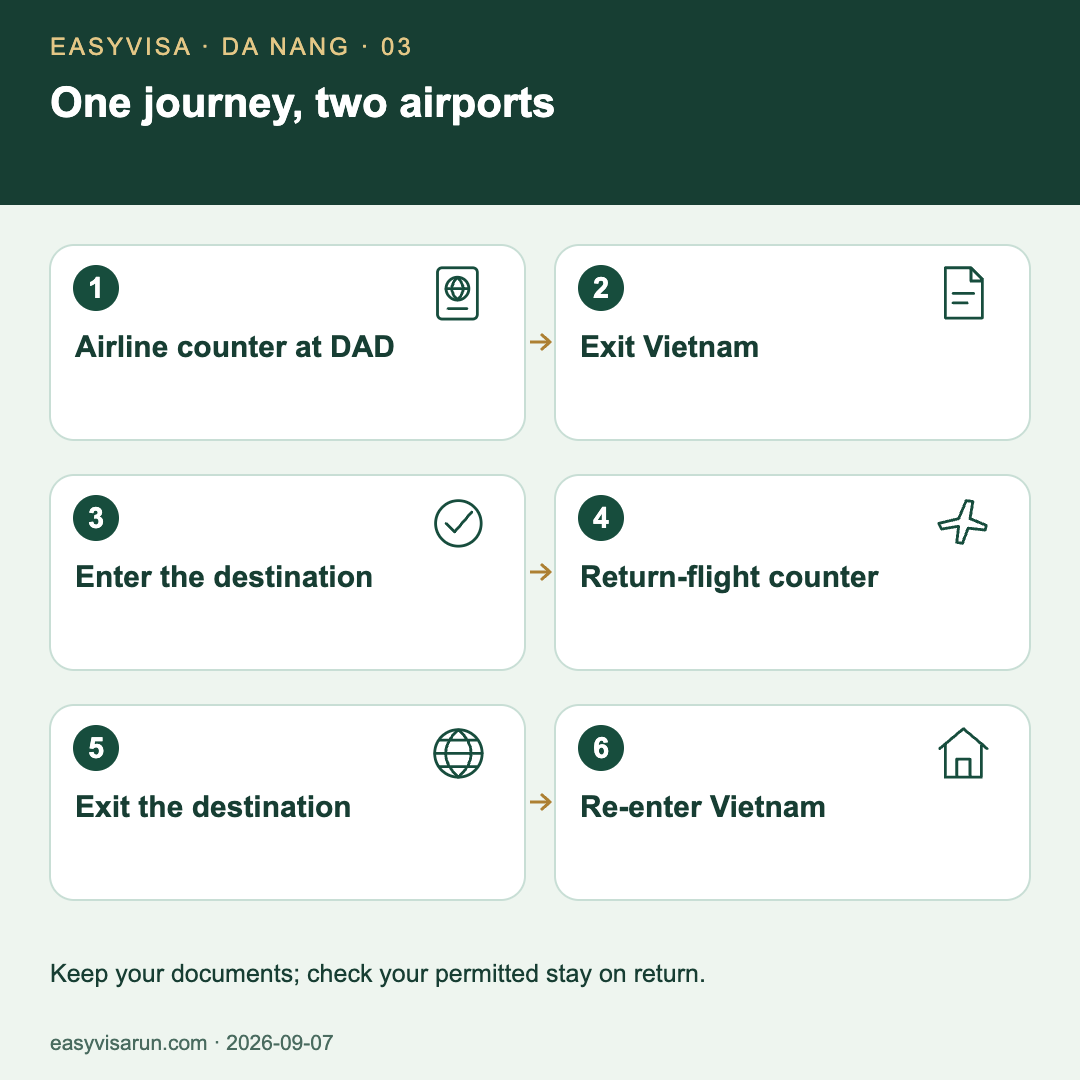
An air visa run involves airline document checks and border formalities in both Vietnam and the destination. A wrong visa start date, airport or check-in deadline can turn a cheap fare into an unexpected night abroad.
Part 3 turns the legal explanation and destination comparison into a working checklist. Figures are planning assumptions dated 7 September 2026, not a published service package or a bookable quote.
1. Settle document eligibility before fare hunting
Record nationality, passport type and expiry, current Vietnam status, departure deadline and the basis for your return. A used single-entry visa cannot be reused after departure; multiple entry does not add validity each time you travel.
If you need the personal e-visa application route for foreigners outside Vietnam, allow for departure and waiting abroad. You can research fares early, but do not buy an inflexible return assuming approval within the day. A processing application does not replace issued permission.
Choose the destination after checking entry rights for your passport. Resolve special requirements for children, overstay cases, passports nearing expiry or unusual documents before paying.
62/VBHN-VPQH (2026) · 16a, 20–21, 27–28, 31, 33, 35 · evisa.gov.vn
2. Compare airlines and both directions together
Try nearby dates within your lawful Vietnam stay, comparing same-day and overnight options. Early booking can improve choice but does not guarantee a lower price; midweek is not invariably cheaper. Compare the total price of a usable flight pair.
- Bangkok: check Thai AirAsia for DMK and Thai Vietjet for BKK. Record the airport code both ways; the city name can conceal an airport change.
- Kuala Lumpur: check AirAsia DAD–KUL, arrival time, terminal and return. A late outbound often fits an overnight trip better.
- Singapore: compare Scoot and Singapore Airlines using the baggage and change rules for each selected fare, not one airline’s rules applied to both.
- Hong Kong: check HK Express after resolving visa/entry-permit eligibility. Add taxes, charges and chosen baggage at checkout before comparing.
- Every airline: verify nonstop status, operating carrier, passenger names, local dates/times, counter deadlines, baggage, no-show and change conditions. Save the confirmation and fare conditions at purchase.
Thai AirAsia · DAD–DMK · Vietjet · DAD–BKK · AirAsia · DAD–KUL · Scoot · DAD–SIN / Check-in · Singapore Airlines · DAD–SIN · HK Express · DAD–HKG
3. Worked Bangkok budget: include the separate costs
Add about VND 650,000 (USD 25) for a new single-entry Vietnam e-visa or about VND 1.31M (USD 50) for multiple entry if required. These VND figures are approximate; use the payment provider’s actual exchange rate and card fees instead of assuming a fixed VND conversion. Add a destination visa if required, chosen checked baggage, assistance if used and accommodation while waiting for documents.
For initial return-airfare planning, EasyVisa estimates Bangkok at VND 3.5–6.5 million; Kuala Lumpur 4.5–8 million; Singapore 5–9 million; Hong Kong 4.5–9 million. These are not confirmed quotes and may be exceeded on short notice or convenient schedules. Obtain a dated quote identifying both flights, operating carriers, inclusions and refund/change conditions.
There is no universal immigration-stamp charge to reset 90 days. An assistance charge should not be labelled a government fee. Do not add a new application fee when your existing valid entry basis makes it unnecessary.
| Item | Assumption | Explanation |
|---|---|---|
| Return economy flights | 4,600,000 | Target includes ticket taxes/fees and the fare’s cabin allowance. |
| Da Nang airport transfers | 300,000 | Both directions; replace with an actual quote. |
| Food and connectivity | 400,000 | Airport-based allowance; city travel costs extra. |
| Expected spend before visas/services | 5,300,000 | 4,600,000 + 300,000 + 400,000. |
| Separate contingency fund | 2,000,000 | Illustrative; may not cover a new ticket and hotel. |
| Available budget in this example | 7,300,000 | Still excludes the additional items below. |
4. Before departure: forms and offline documents
- Match the passport to tickets and permissions; print the issued e-visa, save its PDF, booking references and airline contact details.
- Check your intended Vietnam airport/checkpoint. If the itinerary changes from the application, obtain guidance from the carrier and Immigration before travel.
- Thailand: TDAC as required in the three-day pre-arrival window. Malaysia: MDAC within the three-day window unless exempt. Singapore: free SG Arrival Card within three days including arrival day when clearing immigration.
- Declare actual flights, arrival/departure dates and accommodation or itinerary. An arrival declaration is not a visa, and paying an intermediary does not prove permission to enter.
- Weigh and measure baggage against each fare’s allowance. Keep passport, documents and essential medicines in your cabin bag; prepare an internationally usable payment card and email access.
- Check fresh airline notices and Vietnam arrival guidance, including any pre-arrival declaration applicable to your route. Complete official forms according to their current scope.
Thailand Immigration · TDAC · Malaysia Immigration · MDAC · Singapore ICA · Entry / SGAC · evisa.gov.vn
5. At Da Nang: check-in, departure control and security
International services at Da Nang normally use T2; reconfirm with the ticket and carrier. Plan to reach the airport around three hours before departure for document checks even after online check-in. This preparation allowance does not replace the airline’s actual opening and closing times.
Present the passport and destination documents when requested. Collect the boarding pass, check baggage if needed, confirm the gate, then complete exit control and security. Reach the gate by the boarding deadline. The airport process does not regularise an overstay.
If an outbound delay tightens the return connection before you leave, reassess both flights immediately. Contact the airline or seller before no-show deadlines instead of only waiting at the gate.
6. Abroad: enter, then check in for the return
The itinerary described here involves lawful entry to the destination, baggage collection when required and proceeding landside. Keep electronic entry confirmation where used; not every country applies a paper stamp. Explain the short trip truthfully and show the return ticket, Vietnam permission or other requested evidence.
Reach the correct terminal and return counter before closing. The carrier may require an in-person Vietnam document check despite an online boarding pass. Scoot, for example, publishes a counter closing time of 60 minutes before departure; that is a deadline, not a suitable time to have only just landed.
Go into the city only with ample time after subtracting formalities and ground travel. A 5–6-hour overseas interval is a cautious starting point for a self-transfer search, not a connection guarantee. Where the tickets require entry to check in again, do not substitute an assumed transit passage.
7. Missed flights, delayed documents and boarding refusal
- Separate tickets: ask the seller immediately about changes, no-show deadlines and costs. Do not assume the outbound carrier must rebook the return on another ticket.
- Pending e-visa: track the official application reference, provide requested corrections and remain lawfully in the destination. Confirm the return only when an accepted entry basis exists.
- Mismatched visa or passport: request instructions from the issuing authority; never edit an issued PDF yourself.
- Destination admission refused: follow border-authority and carrier instructions. A purchased return ticket does not automatically resolve document problems.
- Extra costs: keep receipts, flight notices and fare rules for any airline or insurance claim covered by the contract. Your contingency allowance is not promised airline compensation.
8. Back in Vietnam: verify the stay and update your address
Clear Da Nang immigration using the intended document or exemption. Check the recorded permitted-stay date and ask immediately if it differs from expectations. Do not count another 90 days simply from landing.
Collect baggage, complete customs requirements where applicable and return to your accommodation. Give the hotel or host your new entry information for the Article 33 residence declaration. Put the expiry on your calendar and plan the next step early.
For an EasyVisa quote, send nationality, passport expiry, current stay deadline, intended entry basis, travel-date range and baggage needs through a private support channel. Do not post passport images in Facebook comments. Ask for government fees, airfare and assistance to be itemised.
Frequently asked questions
Do I still need the counter after online check-in?
Possibly. The airline must check entry documents and may direct you to the counter. Follow the instructions for your flight and arrive before its closing deadline.
Must both flights use the same airline?
No, but check airports, terminals and both tickets’ conditions. Using one airline does not automatically protect a connection purchased as separate tickets.
Is VND 7.3 million an EasyVisa package price?
No. It is a hypothetical budget including an illustrative contingency fund, excluding visas and services. A real quote requires dates, documents and a specific flight pair.